
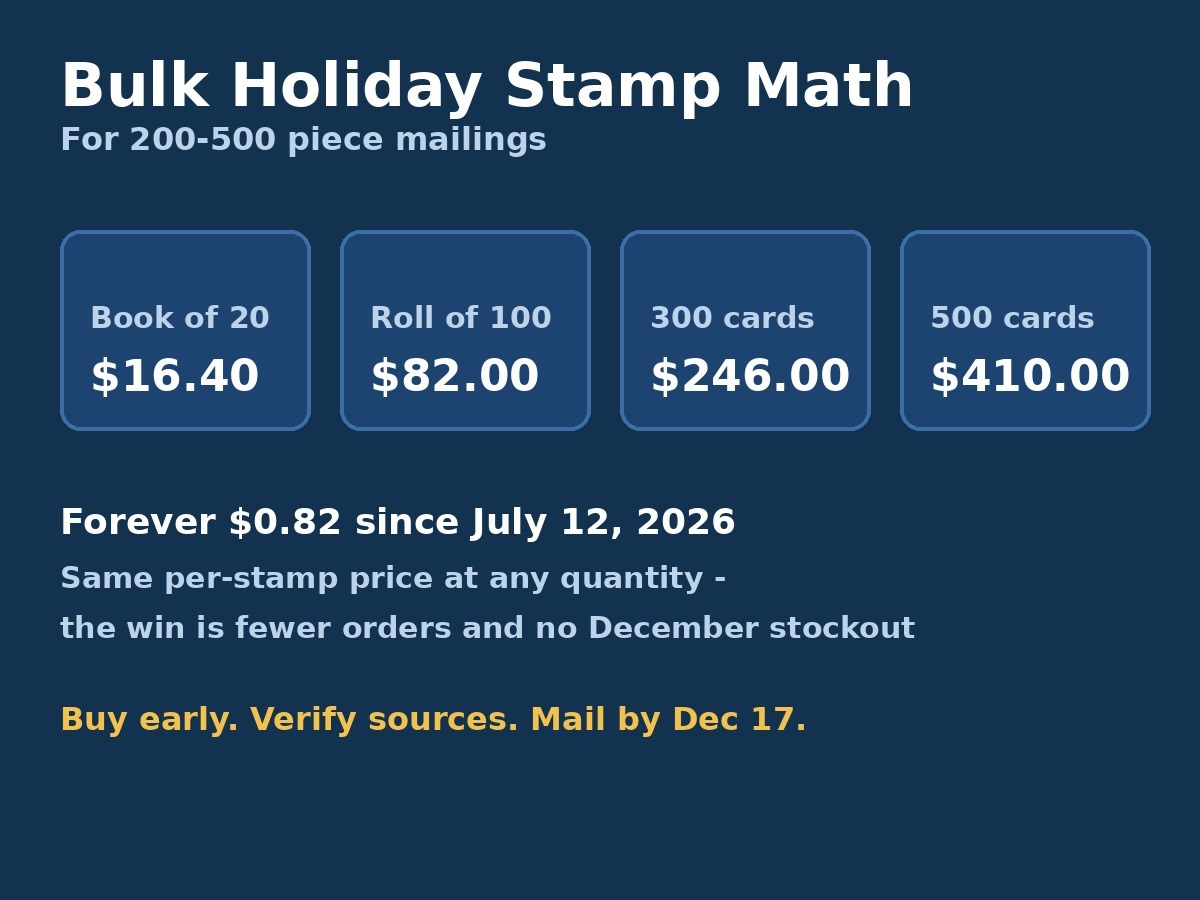
A small business mailing 200–500 holiday pieces should buy its stamps in one November order: at the current $0.82 Forever rate, that’s $164–$410 of postage, and buying once beats five December orders on every count except shelf space.
This guide covers the order-size math, the book-versus-roll decision, why the purchase doubles as a rate hedge, and the three checks that keep a bulk order legitimate.
Key Takeaways
- 200 stamps = $164; 300 = $246; 500 = $410 at the $0.82 rate — same per-stamp price as a single book of 20.
- The rate rose from $0.78 to $0.82 on July 12, 2026. Forever stamps bought today hold full value through any future increase.
- Books of 20 ($16.40) and rolls of 100 ($82) cost the same per stamp; rolls win on logistics at holiday volume.
- Verify bulk sellers on three points: tracked shipping, factory-sealed packaging, pricing consistent with USPS retail.
- Add a 10–15% buffer for heavier pieces and address corrections before placing the order.
Order-Size Math for the 200–500 Tier
| List size | +15% buffer | Postage cost | Practical purchase |
|---|---|---|---|
| 200 | 230 | $188.60 | 2 rolls of 100 + a book of 20 + 10 singles |
| 300 | 345 | $282.90 | 3 rolls of 100 + books of 20 |
| 400 | 460 | $377.20 | 4 rolls of 100 + 3 books |
| 500 | 575 | $471.50 | 5 rolls of 100 + 3–4 books |
The buffer is not waste: it absorbs the heavier cards (each additional ounce costs $0.29), the address corrections, and the personal mail that inevitably borrows from the business box. Leftovers roll into January invoice mail — Forever stamps never expire.
Keep the buffer in whole rolls where possible: a partial roll is harder to store, count, and reconcile at year-end.
Books, Rolls, and Why Price Isn’t the Difference
At USPS retail, a stamp is $0.82 whether it comes from a book of 20 or a roll of 100. What changes is operational:
- Books of 20 fit small batches and design variety — useful when you’re mixing seasonal designs across a list.
- Rolls of 100 fit campaigns: one purchase, one storage unit, no mid-campaign stockout on December 12.
- Multiple rolls are how the 200–500 tier buys — and ordering them together is what makes the season a solved problem.
Example (assumptions stated): a 350-piece campaign with 12% square cards. 308 standard cards × $0.82 = $252.56; 42 square cards × $1.31 = $55.02. Total $307.58 — 308 Forever stamps (three rolls plus a book) and 42 butterfly stamps, ordered once.
Budgeting the Whole Campaign, Not Just the Stamps
Stamps are the biggest single line in a card campaign, but not the only one. A realistic per-piece budget for a 300-card mailing runs about $1.50–$1.80 all-in: $0.82 postage, $0.20–$0.35 for the card and envelope, and the rest in printing plus the labor of signing and addressing. At 300 pieces that’s roughly $450–$540 total — a number worth knowing before the season, because it turns “can we afford the card campaign?” into arithmetic instead of a guess. It also clarifies where savings actually live: the stamp rate is fixed by USPS, so the real levers are card format (a flat printed card avoids the second stamp), list hygiene (bad addresses are pure waste), and ordering once instead of paying for rush replacements in December. The all-in figure is also the case for starting in November: every task pushed into December costs more per hour, if the help is available at all.
The Purchase That Doubles as a Rate Hedge
USPS held stamp prices flat in January 2026, then raised the Forever rate four cents on July 12. The next regular adjustment window is January 2027. Buying 500 stamps in November at $0.82 locks in first-ounce coverage through the season and beyond — if rates rise in January, every stamp in the drawer still covers a full letter. There is no scenario where a Forever stamp loses value by being bought early.
The Three-Point Seller Verification
Bulk demand attracts counterfeit operations, and their signature is the discount: rolls “worth” $82 listed at $40–$50. Counterfeit stamps lack USPS security microprinting, so mail bearing them can be treated as unpaid, seized, or destroyed — a lost campaign, not a bargain.
- Tracked shipping. A real seller hands you a tracking number within the dispatch window stated at checkout.
- Factory-sealed packaging. Genuine rolls and books arrive sealed; repackaged stock is a warning sign.
- Sane pricing. Prices consistent with USPS retail indicate genuine product; deep discounts indicate counterfeit.
Suspicious listings can be reported to the USPS Postal Inspection Service.
Splitting One Order Across Designs

A single bulk order can still carry several designs. The simple allocation: one design for the general list (Christmas Cookies is the flexible choice), the Hanukkah and Kwanzaa designs for recipients you know observe them, and Winter Wreath Global stamps for any international addresses on the list. Sort the list first, count each segment, then buy to the segment counts plus the shared buffer — the math in the table above works the same whether the order is one design or four. What to avoid is buying design-first: a drawer full of Hanukkah stamps with a mostly Christmas list, or the reverse, is the one bulk-buying mistake no buffer fixes. Label the storage boxes by segment so the stuffing line never has to make design decisions on the fly.
Timing: Why November Beats December
Three reasons, in order of cost: verified sellers’ shipping windows tighten as demand peaks; the First-Class mail-by date of December 17 leaves no time to fix a procurement problem; and November pricing is the hedge window before any January rate adjustment. Order the moment the list is final — stamp procurement doesn’t need to wait for card design.
Businesses that order in November also get first pick of seasonal designs before counter stock thins — the design-mix problem compounds the closer you get to the deadline.
Sources
One order, one buffer, one verification pass — that’s the whole procurement plan. Verified bulk Forever stamps for the 200–500 tier are here.

Former USPS employee with 5 years of service and 25 years in corporate mailing management. Certified in Mail Systems Management and trained at the USPS Business Mail Academy, Kobe now shares trusted guidance on U.S. postage stamps and safe buying practices after retiring in 2023.
