
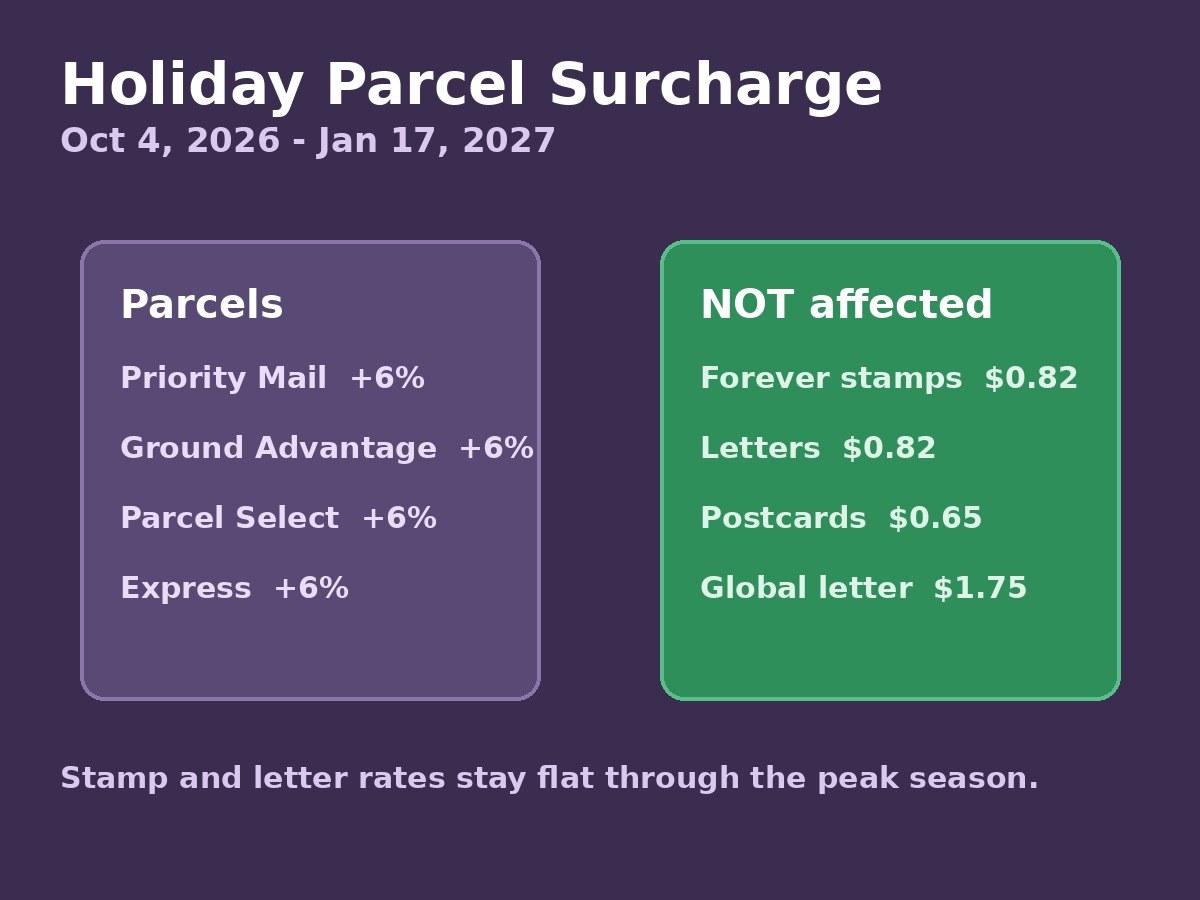
The 2026 holiday surcharge does not raise stamp prices. The temporary adjustment USPS filed for the peak season runs October 4, 2026 through January 17, 2027, and it applies to package services only — Priority Mail, Priority Mail Express, Ground Advantage, and Parcel Select. Forever stamps, letter postage, and postcards stay at their regular rates all season.
That distinction matters this time of year, because “USPS prices going up for the holidays” headlines make stamp buyers delay purchases that shouldn’t wait.
Key Takeaways
- The surcharge window is October 4, 2026 – January 17, 2027, approved by the Postal Regulatory Commission on September 9, 2026.
- Affected: Priority Mail Express, Priority Mail, USPS Ground Advantage, Parcel Select — roughly a 6% average increase on those products.
- Not affected: Forever stamps ($0.82), First-Class letter postage, postcards ($0.65), international letters ($1.75 Global).
- The surcharge is temporary by design — USPS files it annually to cover peak-season handling costs, and it expires January 17.
- For card-heavy senders, the practical takeaway is simple: stamp-based holiday mail is priced exactly the same in December as in October.
What’s Going Up, and by How Much
The peak-season adjustment raises rates on the four domestic competitive package products. USPS frames the increase as covering extra handling costs during the volume surge between Thanksgiving and mid-January — the same filing it makes most years, and the same expiration date structure: rates return to normal on January 17, 2027.
| Product | Holiday surcharge | Back to normal |
|---|---|---|
| Priority Mail Express | Yes (~6% avg) | January 17, 2027 |
| Priority Mail | Yes (~6% avg) | January 17, 2027 |
| USPS Ground Advantage | Yes (~6% avg) | January 17, 2027 |
| Parcel Select | Yes (~6% avg) | January 17, 2027 |
| Forever stamps & letters | No change | — |
| Postcards & international letters | No change | — |
Why Stamp Buyers Should Ignore the Headlines
Every year, package-surcharge announcements get read as “postage is going up,” and some buyers postpone stamp purchases waiting for a nonexistent letter-rate increase. The confusion is understandable — both stories involve USPS and higher numbers — but the products, the legal mechanisms, and the dates are entirely different. The facts cut the other way:
- Stamp rates changed in July, not October. The Forever stamp’s last move was $0.78 → $0.82 on July 12, 2026 — months before the surcharge window opened.
- The next regular window is January 2027. Buying stamps now locks in coverage ahead of that date, since Forever stamps hold full value through any increase.
- Waiting has a real cost. A stamp order delayed into mid-December collides with tightened shipping windows and the December 17 mail-by date.
Every rate on this page is verified against USPS Notice 123 and updated the same day rates change — so the $0.82 you read here is the rate your envelopes will actually pay.
How the Surcharge Shows Up on a Real Label

The ~6% average is a blend, not a flat tax. The adjustment is scaled by zone and weight, so a lightweight parcel crossing two zones might see 3–4% while a heavier box headed across the country sees more. On a $10.40 Ground Advantage base rate, that’s roughly 60 cents; on a $25 Priority shipment, closer to $1.50. Neither number changes what a stamp costs, but both belong in December margin math for anyone shipping product. USPS publishes the exact holiday price files on its pricing site; if a parcel quote looks off by more than the rough percentages above, check whether the surcharge is already included. The practical habit: price December parcels from the current holiday rate table rather than October’s, and re-check after January 17 when standard rates return.
Why Packages Get a Surcharge and Letters Don’t
The split isn’t arbitrary. Package products are “competitive” services — they compete with UPS and FedEx, and USPS can adjust their pricing seasonally the way private carriers do; both of those carriers publish their own peak-season fees. Letters and stamps are market-dominant, rate-regulated products that only move through the formal rate-setting process, most recently the July 12 adjustment. That regulatory line is why no holiday filing can touch the $0.82 Forever rate: the surcharge mechanism simply doesn’t apply to it. It’s also why the pattern repeats every year — expect a similar peak-season filing again in fall 2027.
Planning Around the January 17 Reversal
For parcel-heavy operations, the expiration date is as useful as the surcharge itself. Non-urgent shipments — restock orders, B2B parcels, anything without a holiday deadline — can wait until January 18 and ship at standard rates. Returns are the classic case: holiday purchases come back in January, and a return label generated after the reversal costs about 6% less. Subscription-box shippers can time the January billing cycle after the expiration date for the same reason. Set a calendar note for mid-January; the reversal happens automatically, but only if the shipment waits. Card mailers don’t need any of this — which is the point of this page: one part of the operation watches the calendar, the other can ignore it entirely.
Who Should Care About the Surcharge
The surcharge is a real cost for shippers — small businesses moving products in December should price it into margins or shift non-urgent parcels to January. But it’s a non-event for card mailers: a First-Class letter, a Priority envelope of documents aside, stamp-based correspondence is untouched. If your holiday operation is cards, invitations, and invoices, the surcharge changes nothing about your postage math.
Example (assumptions stated): a business sending 300 holiday cards and 50 December product parcels. Card postage: 300 × $0.82 = $246, unchanged by the surcharge. The 50 parcels, however, pay the peak-season Ground Advantage rates — on a $10 base rate, roughly $0.60 extra each, about $30 across the batch. Knowing which half of the operation the surcharge touches is the whole point. The same split applies to shipping supplies: envelopes and boxes cost the same all season — only the parcel rate moves.
One more distinction worth keeping: the surcharge applies at purchase, not at the mailbox — nothing about it changes how stamps are sold, priced, or used.
Sources
Cards and letters ride through the season at unchanged rates. Verified Forever stamps at the current $0.82 rate are here, with deadlines in our 2026 deadline guide.

Former USPS employee with 5 years of service and 25 years in corporate mailing management. Certified in Mail Systems Management and trained at the USPS Business Mail Academy, Kobe now shares trusted guidance on U.S. postage stamps and safe buying practices after retiring in 2023.
