
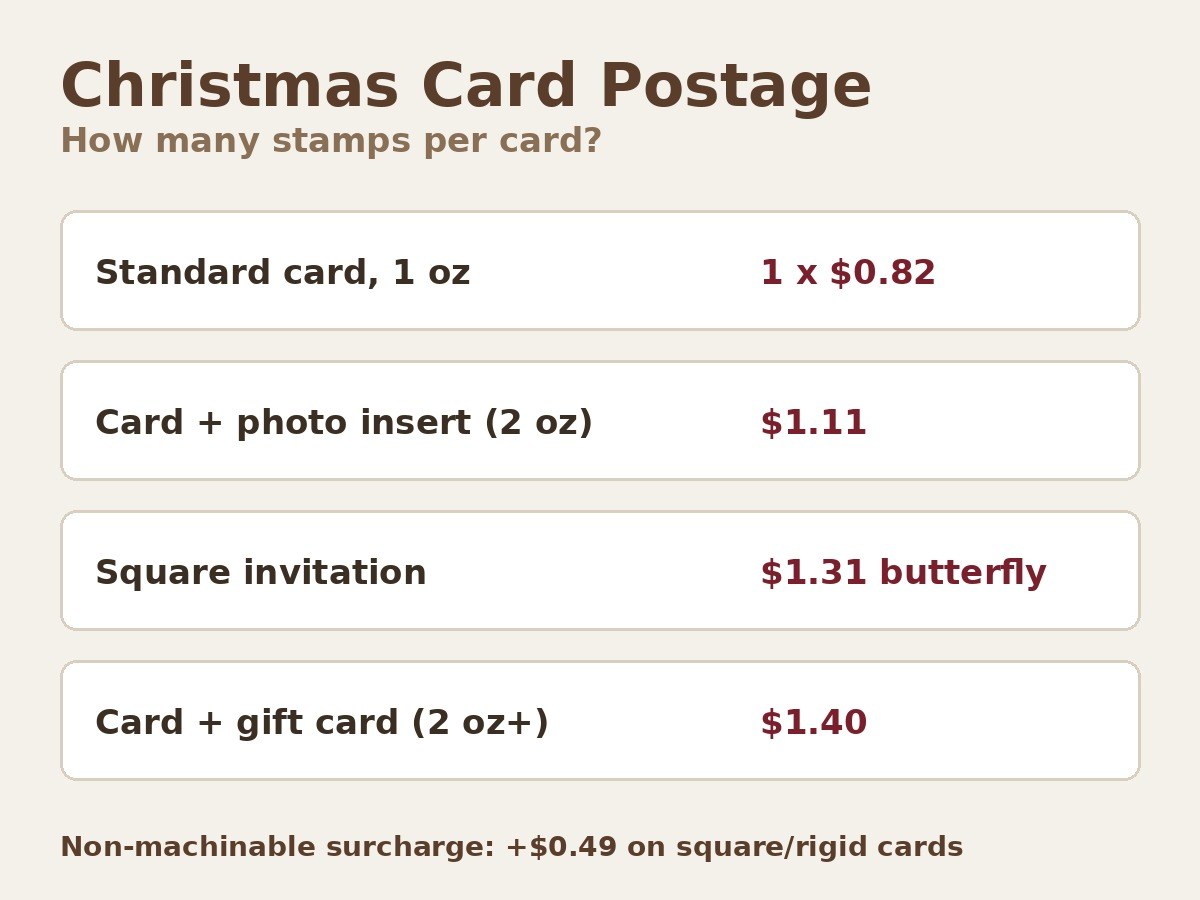
One $0.82 Forever stamp covers most Christmas cards. The exceptions are predictable: cards with photo inserts or gift cards usually need a second stamp ($1.11 total for 2 ounces), and square or rigid cards take the $1.31 butterfly stamp instead — a single stamp that covers the non-machinable surcharge exactly.
Here’s the count by card type, with the weight math that explains why the second stamp keeps surprising people.
Key Takeaways
- Standard rectangular card, one ounce or less: one $0.82 Forever stamp.
- A sheet of copy paper weighs about 0.16 oz — four to five sheets plus a card pushes past one ounce.
- 2-ounce letter: $1.11 (one Forever + one $0.29 additional-ounce stamp).
- Square, rigid, or clasped cards: +$0.49 non-machinable surcharge — or one $1.31 butterfly stamp, no math.
- International Christmas cards: one $1.75 Global Forever stamp.
The Count by Card Type
| Card type | Postage needed | Stamps to use |
|---|---|---|
| Standard card + envelope, 1 oz | $0.82 | 1 Forever stamp |
| Card with 4–5 sheets or newsletter, 2 oz | $1.11 | 1 Forever + 1 additional-ounce stamp |
| Photo card with insert, 2 oz | $1.11 | 1 Forever + 1 additional-ounce stamp |
| Card with gift card or coin, 2 oz+ | $1.40 | 1 Forever + 2 additional-ounce stamps |
| Square invitation-style card, 1 oz | $1.31 | 1 butterfly stamp |
| Christmas postcard | $0.65 | 1 postcard-rate stamp |
| International card, 1 oz | $1.75 | 1 Global Forever stamp |

Why the Second Stamp Keeps Surprising People
The one-ounce limit sounds generous until you weigh a real envelope. A standard greeting card runs about 0.3–0.5 oz, an envelope another 0.2 oz — but add a photo insert, a handwritten newsletter, or a gift card and the envelope lands between 1.1 and 1.6 ounces. USPS rounds up to the next ounce, so 1.05 oz bills as a 2-ounce letter: $1.11.
Kitchen scales read grams; 28 grams is the one-ounce line. Anything within 10 grams of the line should get the second stamp — a returned or postage-due card costs far more goodwill than a $0.29 stamp. Batch mailers should also remember that greeting-card envelopes from different manufacturers vary by a few grams — the envelope you weighed last year isn’t necessarily the envelope you’re stuffing this year.
Square Cards: The Butterfly Stamp Fixes It in One Move
Square envelopes — the invitation-style cards that look so good — can’t pass through USPS sorting equipment, so they carry a $0.49 non-machinable surcharge on top of the letter rate. That makes a square one-ounce card $1.31.
You can stack Forever stamps to get there ($0.82 + $0.49 worth of smaller denominations), but USPS prints a $1.31 butterfly stamp for exactly this case: one stamp, one placement, done. It’s also why our business design guide tells senders to sort square cards into their own batch before stamping.
No Scale? Two Reliable Workarounds
A kitchen scale set to grams does the job: 28 grams is the one-ounce line, and anything over 28 grams bills as 2 ounces. Weigh five envelopes from different parts of the batch, not just one — inserts vary. If you don’t have a scale at all, use the paper rule: a standard card plus envelope stays under one ounce unless something extra goes inside, so treat every newsletter, photo insert, or gift card as a second-stamp card automatically. Over-stamping a light card costs 29 cents; under-stamping costs a postage-due notice and a delayed delivery. When the batch matters — client cards especially — the $0.29 insurance beats the guess every time.
Where the Stamps Go (and the Mistakes That Slow Mail Down)

Placement is simple: upper right corner of the envelope, flat, fully on the face. The mistakes that actually cause problems: stamps hanging over the envelope edge get shaved off by sorting machines; tape or glue over a stamp stops the cancellation ink from adhering and can send the piece to the dead-mail office; and stacking three Forever stamps on a 2-ounce card works, but takes the sorter longer to read than one Forever plus one additional-ounce stamp. Address in permanent ink, keep the bottom third of the envelope clear for the barcode, and put your return address in the upper left — it’s what gets the card back if the recipient has moved.
What Happens If You Underpay
An under-stamped card isn’t refused — it’s rerouted. USPS sends it to the recipient with a postage-due notice, which means the person receiving your Christmas card pays the difference at the door, or the card sits at the local office until it goes back to the sender. Either outcome costs more goodwill than the $0.29 you saved. For business mail the stakes are higher: a batch of postage-due cards reads as carelessness to exactly the clients you were trying to impress. This is why the sample-weigh habit matters — pull five random envelopes from the finished batch, weigh them, and stamp for the heaviest reading, not the average.
And if a card does come back postage-due, correct the whole batch before mailing the rest — the same envelope error repeats across every identical card in the run.
Counting for the Whole List
Sort your list into standard and special-handling batches, then count each batch separately:
- Standard cards: headcount + 10–15% buffer, one stamp each.
- Square/rigid cards: one butterfly stamp each ($1.31).
- Heavy cards: one Forever + additional-ounce stamps ($0.29 per extra ounce).
- International: one Global stamp each ($1.75).
Example (assumptions stated): a 300-card list — 255 standard, 30 square, 15 international. Cost: 255 × $0.82 = $209.10; 30 × $1.31 = $39.30; 15 × $1.75 = $26.25. Total $274.65 across 300 envelopes, all covered by one purchase.
Recount after any design change, too: swapping a photo insert for a flat printed card moves a whole batch back down to one stamp, and nobody notices until the envelopes are sealed.
Every rate in this guide is verified against USPS Notice 123 and updated the same day rates change — if the math doesn’t add up, we don’t publish it.
Sources
Sort the batches, count twice, mail by December 17 — the full deadline table is in our 2026 holiday deadline guide. Verified bulk Forever stamps are here.

Former USPS employee with 5 years of service and 25 years in corporate mailing management. Certified in Mail Systems Management and trained at the USPS Business Mail Academy, Kobe now shares trusted guidance on U.S. postage stamps and safe buying practices after retiring in 2023.
