
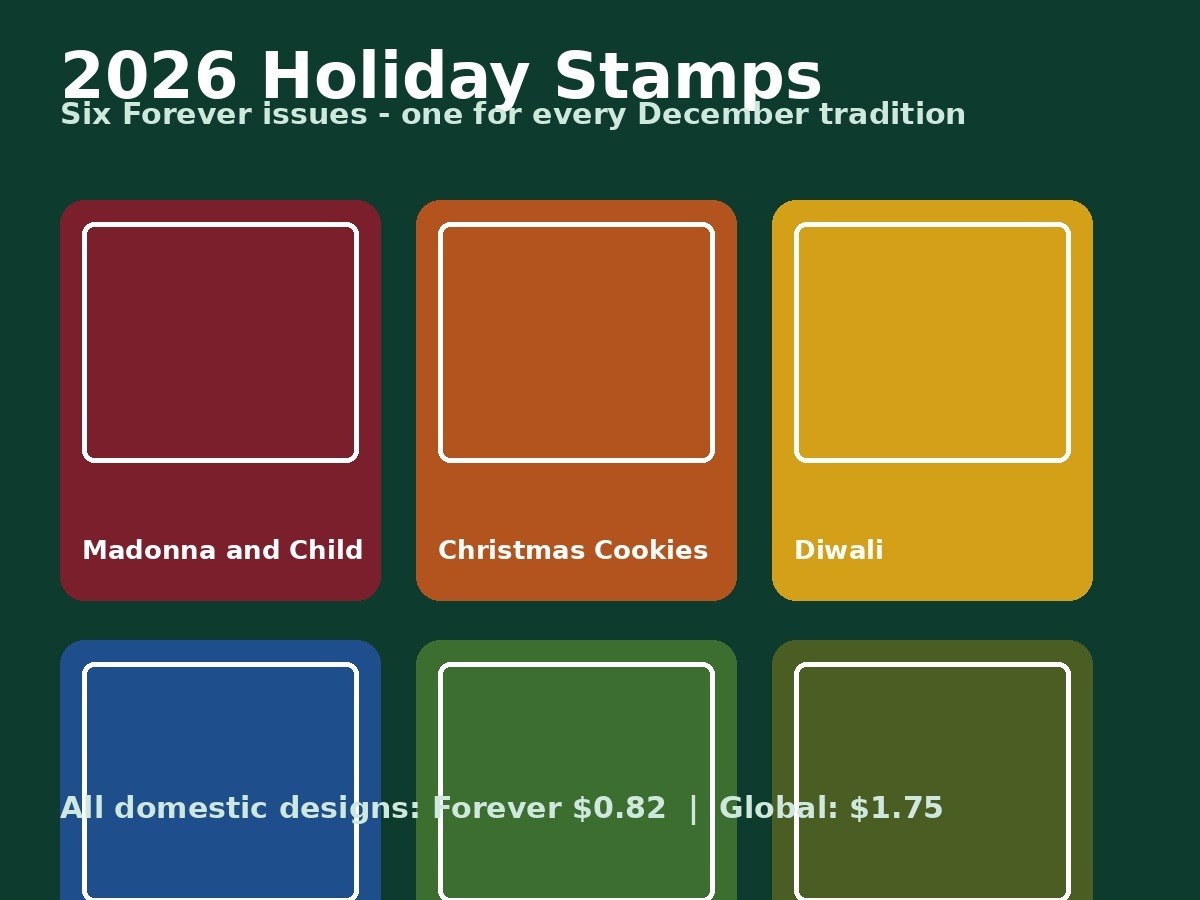
USPS issued six holiday stamps for 2026 — two Christmas designs, one Hanukkah, one Diwali, one Kwanzaa, and one Global stamp for international mail — and every domestic design carries the same $0.82 Forever value. The fastest way to pick the right one is to sort your card list by recipient, not by artwork.
That is how this guide is organized: each section below matches one kind of recipient to the design that fits, with the release dates and rates verified against USPS announcements.
Traditional Christmas Lists Get Madonna and Child
The 2026 Madonna and Child stamp reproduces The Virgin and Child Enthroned, a Netherlandish painting from around 1500 held in the Clark Art Institute collection, and continues a Christmas stamp tradition that reaches back to 1966. USPS printed roughly 185 million of them for this season, the kind of run that keeps the design on shelves deep into December. For faith-based organizations and traditional card lists, this is the anchor choice at $0.82.
Prefer something secular for the same list? Christmas Cookies, the season’s other Christmas design, shows four sugar-frosted cookies and works on any December envelope without a religious note.
Mixed-Faith Client Lists Pair Three Designs at One Rate
Most small-business card lists mix traditions. The practical pairing is Christmas Cookies for the general list, the Hanukkah dreidel design for recipients who observe the Festival of Lights, and the Kwanzaa stamp for recipients who celebrate the pan-African holiday from December 26 to January 1. All three are Forever stamps at $0.82, so the pairing changes nothing about postage — a mixed list costs exactly the same as a uniform one.
Our business greeting design guide walks through matching designs to recipient segments in more depth.

Hanukkah Cards Run on the Earliest Clock
Hanukkah 2026 begins at sundown on December 4 and ends December 12 — earlier than most seasons, which compresses the mailing window. The 2026 dreidel stamp, the ninth Hanukkah issue in the series, went on sale September 29. Cards for this list should be stamped, addressed, and in the mail by late November.
Diwali and Kwanzaa Complete the Calendar
The Diwali stamp, released October 21, is the second in USPS history and shows a rangoli, the colorful floor pattern made from colored rice powder, chalk, and flower petals; the festival’s main day falls on November 8 in 2026. The Kwanzaa stamp, issued September 23, is the eleventh in its series and depicts a father holding his young daughter. Both are $0.82 Forever stamps, and both reward senders who match the design to the actual holiday date rather than a generic December schedule.
International Clients Need Exactly One Stamp
The Winter Wreath Global stamp, released September 18, pays the $1.75 international first-ounce letter rate exactly. Three domestic Forever stamps would overpay that letter by 71 cents and still need a rate check every time international prices move. One Global stamp removes the arithmetic — and the snowy wreath design reads as festive in any country.
The 2026 Release Calendar at a Glance
| Release date | Design | Rate |
|---|---|---|
| September 18 | Winter Wreath (Global) | $1.75 |
| September 19 | Christmas Cookies | $0.82 Forever |
| September 23 | Kwanzaa (11th issue) | $0.82 Forever |
| September 29 | Hanukkah dreidel (9th issue) | $0.82 Forever |
| October 2 | Madonna and Child | $0.82 Forever |
| October 21 | Diwali rangoli (2nd issue) | $0.82 Forever |
What the Lineup Costs in Every Format
| Format | Count | Price | Per stamp |
|---|---|---|---|
| Book | 20 | $16.40 | $0.82 |
| Roll | 100 | $82.00 | $0.82 |
| Global stamp | each | $1.75 | $1.75 |
Example (assumptions stated): a business covering 200 domestic cards and 20 international clients buys 220 Forever stamps ($180.40) plus 20 Global stamps ($35.00) — $215.40 in one order, with the design mix allocated across the five domestic issues.
Forever Stamps Never Expire — but Designs Do Vanish

Every domestic stamp in the lineup is a Forever stamp, which means it stays valid at the first-ounce letter rate no matter how rates move later. Leftover Madonna and Child stamps in January are worth exactly what you paid in December. What does expire is availability: seasonal designs are printed for one season, and once USPS sells through the run, the only sources left are collectors and resellers at a markup. That asymmetry — no financial risk to buying extra, real risk to waiting — is why the November order matters more than the January one.
Storage is simple but worth doing right. Keep stamps in their original backing, away from sunlight and humidity, and they will still adhere properly next December; a stamp that has been through a hot car or a damp drawer can curl and fail to stick, which turns a batch mailing into a re-stamping job. If you over-ordered, unused Forever stamps carry forward at full value — nothing is wasted, and the surplus simply becomes the start of next year’s card budget.
Buy in November, Before the Lists Go Out
Seasonal designs are printed in fixed quantities, and the traditional Christmas issues always draw the heaviest demand. Ordering in November means the design mix you want arrives before counter stock thins in mid-December. For a 200–500 stamp season, one bulk order beats a series of book-of-20 errands; our bulk buying guide covers the order-size math.
Ordering early also locks the design mix: once a seasonal design sells out at the counter, substitutions are the only option, and the substitute is rarely the one your card list was sorted around.
Every rate in this guide was checked against USPS Notice 123 and the USPS newsroom release dates, and this page is updated the same day any rate changes — a level of price hygiene most holiday stamp roundups online have not managed since July.
Sources
- USPS Holiday News — seasonal stamps
- USPS Newsroom — Winter Wreath stamp release
- USPS 2026 Postage Price Change FAQ
Six designs, five traditions, one rate sheet — match the stamp to the recipient and the rest of the season runs itself. Verified bulk stock is here in 500-count rolls, and mailing dates live in our 2026 deadline guide.

Former USPS employee with 5 years of service and 25 years in corporate mailing management. Certified in Mail Systems Management and trained at the USPS Business Mail Academy, Kobe now shares trusted guidance on U.S. postage stamps and safe buying practices after retiring in 2023.
